Zume Spent $400M Learning That AI Without a Workflow Map Fails. Miso Just Bought the Wreckage for Pennies.
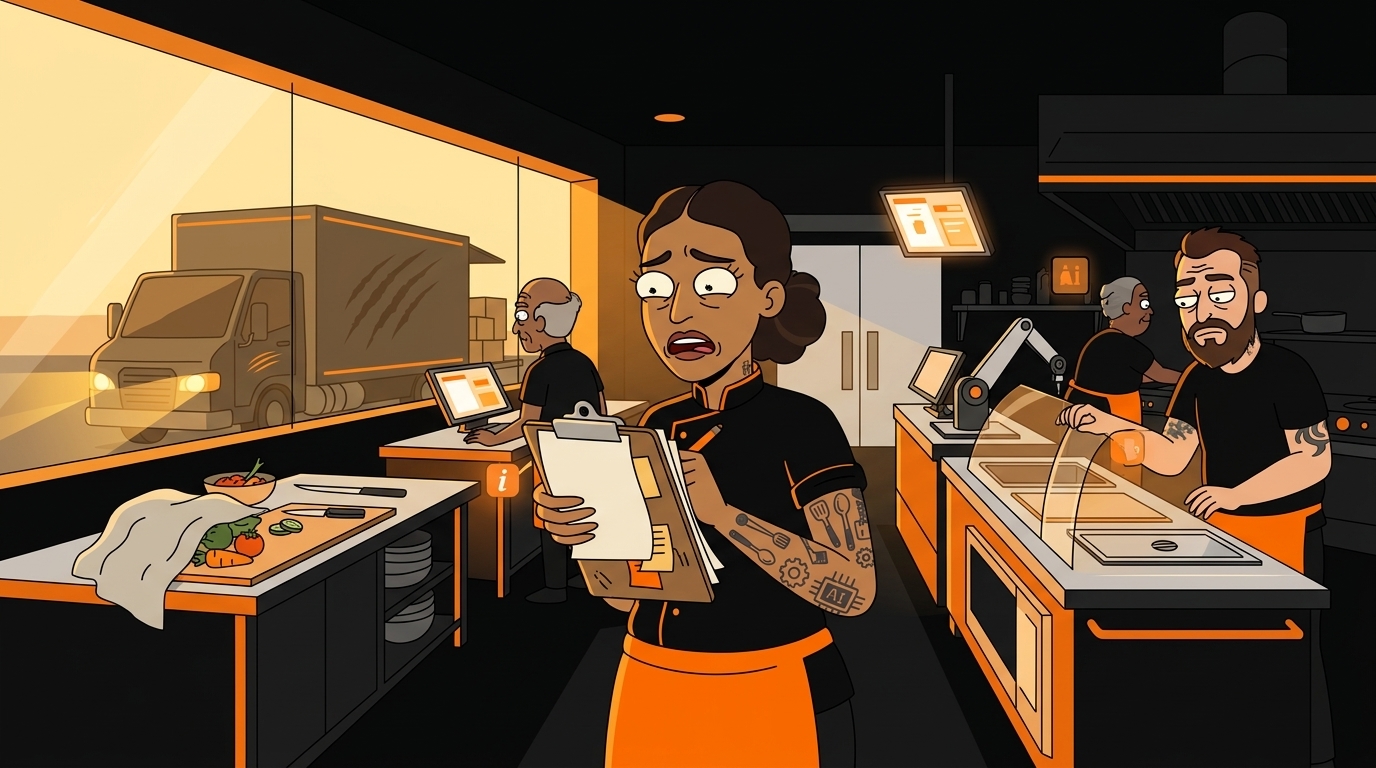
You walk into your kitchen at 6 AM. The delivery truck is late. Your prep cook called out. The new inventory system you just bought? Nobody's logged into it since Tuesday. It's sitting there, gathering digital dust, while your team runs the operation the same way they always have.
That's a $200/month version of what happened to Zume Pizza at $400 million.
What Actually Happened to Zume Pizza?
Zume raised roughly $400 million, including a massive SoftBank investment, to build pizza-making robots inside delivery trucks. The idea was simple: bake pizza on the way to the customer. Fresh, fast, automated.
The technology worked. The workflow didn't.
A moving truck is a terrible place to cook food. The logistics of ingredient prep, food safety in transit, and vehicle maintenance made the operation impossible to scale. Zume shut down in 2023, and the technology sat idle for years. In June 2026, Miso Robotics bought Zume's full technology and IP portfolio - hardware, software, and patents - for pennies on the dollar. (Source: Restaurant Technology News, June 25, 2026)
Miso didn't buy a failure. They bought proven robotics and applied it to a workflow that actually makes sense: stationary kitchen automation. Dough handling, robotic prep, workflow sequencing. The same technology, completely different outcome, because someone finally mapped the workflow first.
Why Did Miso Buy a $400M Failure?
This is the part most people miss. Miso didn't buy garbage. They bought good technology that was deployed into an impossible workflow.
Zume's robots could handle dough, sauce, and toppings with precision. The computer vision for quality control was solid. The automation of repetitive kitchen tasks actually worked. What failed was the delivery truck concept - a workflow problem, not a technology problem.
Miso already has Flippy (the robotic fry cook) deployed in restaurant kitchens across the country. They understand that automation works best at fixed stations with predictable inputs. Buying Zume's tech gives them pizza and broader prep capabilities that complement their existing lineup. Same robots, different workflow, dramatically different results.
Here's what makes this acquisition so telling: Miso's leadership looked at $400 million worth of "failed" technology and saw value. Because they understood the difference between bad tech and bad deployment. Most restaurant owners don't make that distinction. They try a tool, it doesn't work in their specific setup, and they conclude "AI doesn't work for restaurants." That's like saying ovens don't work because you installed one in a food truck with no ventilation.
The lesson for restaurant owners is uncomfortable: the technology wasn't the problem. The plan was.
What Happens When You Buy AI Without Mapping Your Workflow?
Here's the restaurant version of the Zume story. It plays out every week across thousands of operations.
An owner reads about AI inventory tools. Signs up for a $200/month subscription. The tool needs clean data from the POS, consistent receiving procedures, and staff who actually count inventory properly. None of those things exist in the restaurant yet.
The tool sits unused after two weeks. The owner cancels and tells everyone "AI doesn't work." The technology was fine. Nobody mapped the workflow first.
I see three specific patterns repeat:
Pattern 1: The scheduling tool that nobody uses. Owner buys AI scheduling software. But the real bottleneck isn't creating schedules - it's communicating shift changes. The tool optimizes schedule creation, which takes 20 minutes. The actual problem is the 3 hours a week spent texting back and forth about swaps. Wrong tool for the real problem.
Pattern 2: The inventory system that gets abandoned. Staff is supposed to count inventory daily. They do it for a week. Then Friday night hits, and counting walk-in inventory at 11 PM becomes nobody's priority. The system needs consistent data input. The workflow doesn't support it.
Pattern 3: The POS analytics nobody looks at. The POS generates beautiful reports. They sit in an inbox. The owner doesn't have time to read them, doesn't know what to look for, and doesn't have a process for acting on the data. The tool works perfectly. The workflow around it doesn't exist.
According to a 2026 industry survey, 73% of restaurant operators say technology adoption is their number one challenge. Not because the tools are bad, but because nobody takes the time to understand how the operation actually works before throwing software at it. (Source: hooks.json industry data)
I've watched this pattern play out a hundred times. Someone builds or buys amazing technology for a problem they haven't properly defined. Then they wonder why the tool doesn't fit. The restaurant version is owners buying AI scheduling tools before they even know what their actual scheduling bottleneck is. Is it the schedule creation? The shift swaps? The communication? The compliance tracking? Each problem needs a different tool.
How Do You Map Your Workflow Before Buying Anything?
This is where most owners get stuck. They know they need help, but they don't know where to start. Here's a framework that works regardless of your restaurant's size.
Step 1: Document what actually happens, not what should happen. Spend one full shift writing down every task, who does it, how long it takes, and what breaks. Don't fix anything. Just watch and record. You'll be shocked at the gap between the process on paper and the process in practice.
Step 2: Identify the bottlenecks by category. Where does work pile up? Where do people wait? Where does the same task get done differently by different people? Group these into: communication bottlenecks (information doesn't flow), process bottlenecks (steps are wrong or redundant), and data bottlenecks (nobody has the information they need to decide).
Step 3: Rank by impact and frequency. Fixing a bottleneck that happens 50 times a day is worth more than one that happens once a week. A scheduling communication breakdown that affects every shift is worth fixing before a quarterly inventory reconciliation issue. Frequency times impact gives you the real priority.
Step 4: Find tools that fit the workflow, not the other way around. Once you know your actual problems, you can evaluate technology against them. A tool that solves a problem you don't have is worse than no tool at all because it consumes attention, budget, and staff goodwill toward technology in general.
This is exactly what our SWOT assessment does. We map your operation first, identify the real bottlenecks, and then recommend tools that fit your actual workflow. Not generic "AI for restaurants" advice. Specific, grounded analysis of what your operation needs and in what order.
What Happens After You Get the Workflow Right?
When the workflow comes first, everything changes. The technology you buy actually gets used. Your staff adopts it because it solves a real problem they experience every shift. The ROI shows up in weeks, not months.
Chili's is a good example at enterprise scale. Their CIO spent years rebuilding the tech foundation before exploring AI. Years. Not months. Not "let's throw a tool at it and see what happens." They mapped operations, fixed the foundation, then deployed AI on top of a stable base. (Source: Fortune, June 17, 2026)
The same principle works at a single-location restaurant. One owner I talked to spent two weeks just watching how her team handled inventory. She discovered the bottleneck wasn't counting - it was deciding what to do with the counts. The data went into a spreadsheet that nobody analyzed. She didn't need a better inventory tool. She needed a process for acting on inventory data. Once she fixed that, the tool she already had started delivering value.
Here's the ROI math that matters. A $200/month tool that actually gets used saves 5-10 hours of manager time per week. At $25/hour, that's $500-1,000/month in recovered labor. A $200/month tool that sits unused is a pure loss - $200/month plus the opportunity cost of your team's growing cynicism about technology.
The pattern is clear at every scale. $400 million moonshots and $200/month SaaS subscriptions fail for the same reason: nobody mapped the workflow first.
Miso bought Zume's technology for cheap because the previous owners skipped that step. Don't be the restaurant owner whose unused software gets bought for pennies by someone who actually understands operations.
Wondering where your restaurant's workflow actually breaks down? Take the 2-minute quiz to find out. It's free, it takes two minutes, and it'll tell you exactly where to start: clawprime.ai/quiz
Next step
Choose the next practical step for your restaurant.
Check your restaurant's AI readiness or use the SWOT path to identify the most useful operational opportunities.
Keep reading
Related posts
More practical guidance for restaurant operators who want less busywork and better follow-through.
The Restaurant Profitability Gap: Why AI-Using Operators Are Pulling Ahead in 2026
A restaurant owner told me last week that her competitor down the street seems to be thriving while she's barely breaking even. Same neighborhood, same foot traffic, similar menu. The difference isn't
Starbucks Scrapped Its AI Inventory Tool After 9 Months. Here's What Went Wrong.
Your barista just counted the oat milk. The system says you have 14 cartons. You actually have 3. The AI inventory tool that was supposed to save time is now creating a crisis, and nobody caught it un
69% of Restaurants Are Adopting AI. Almost None Can Prove ROI.
Two-thirds of restaurants now use AI. Ask them to show you the return on that investment and you'll get a lot of hand-waving, some vague references to "efficiency," and a strong sense that nobody actu