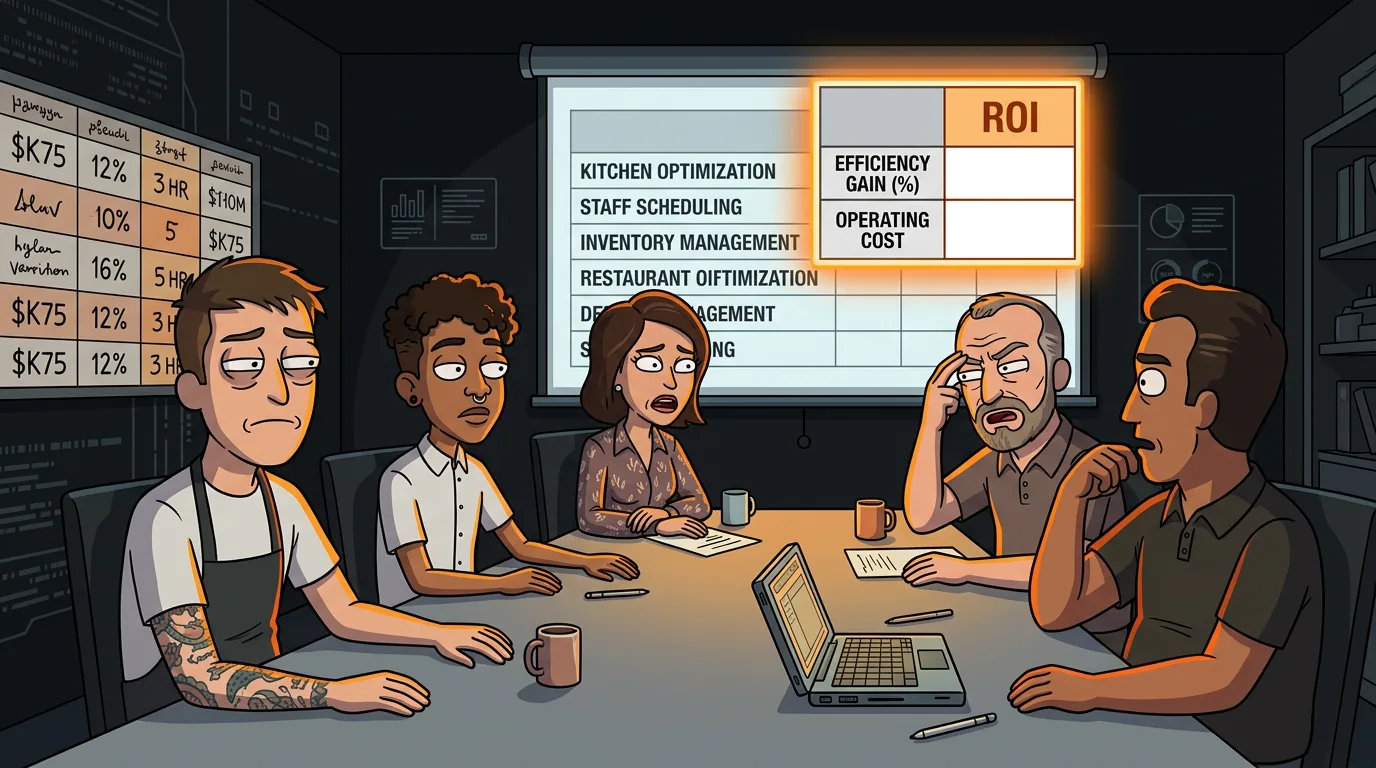
69% of Restaurants Are Adopting AI. Almost None Can Prove ROI.
Two-thirds of restaurants now use AI. Ask them to show you the return on that investment and you'll get a lot of hand-waving, some vague references to "efficiency," and a strong sense that nobody actually measured anything before or after. Everyone's doing it isn't a strategy. It's a spending pattern.
The numbers look great on paper. 69% of restaurants are adopting AI and 81% are increasing digital marketing spend, according to Restaurant Technology News in 2026. Headline numbers paint a picture of an industry racing into the future. But underneath those numbers is a different story: most of these deployments aren't generating measurable returns. Restaurant Business reported that "AI has arrived in restaurants, but ROI is lagging." That's industry-speak for "we spent the money and we're not sure what we got."
What the 69% Adoption Number Actually Means
When 69% of restaurants say they're "adopting AI," that includes a wide spectrum. It includes the multi-location chain that deployed a custom inventory management system with predictive ordering. It also includes the single-location owner who signed up for an AI-powered email marketing tool, used it twice, and forgot the password.
Adoption doesn't mean deployment. Deployment doesn't mean usage. Usage doesn't mean impact. The funnel from "we bought AI" to "AI is saving us money" has a lot of drop-off, and most surveys count everyone at the top of the funnel as an adopter.
The real question isn't how many restaurants are adopting AI. It's how many could tell you, with specific numbers, what their AI tools cost and what they return. Based on what operators tell us and what the trade press reports, that number is much smaller.
Why the ROI Gap Exists
The pattern is consistent across the industry: technology deployed without workflow alignment. Restaurants buy tools at trade shows, sign up for demos after reading a blog post, or get pitched by a vendor rep who sounds convincing. The tool gets set up (maybe), the team gets a 30-minute training (maybe), and then everyone goes back to doing things the way they've always done them.
Starbucks learned this the hard way. They scrapped their AI inventory tool after 9 months, as reported by Restaurant Dive in 2026. Nine months of development, deployment, and testing - gone. Not because the technology was bad, but because it didn't fit how their stores actually operated. The system said they had 14 cartons of oat milk. They actually had 3. When the AI's predictions don't match reality, staff stop trusting the AI. And when staff stops trusting the tool, the tool becomes expensive shelfware.
This is the cautionary tale for every restaurant that thinks buying a tool at the NRA Show equals operational transformation. It doesn't. The gap between "we have AI" and "AI works here" is filled with workflow redesign, staff training, data cleanup, and patience.
The Spending vs. Investing Problem
There's a critical difference between spending on technology and investing in it. Spending is buying the tool. Investing is buying the tool, integrating it into your workflow, training your team, measuring the results, and adjusting when things don't work.
Most restaurants are spending. They're subscribing to platforms, signing annual contracts, and adding line items to their monthly expenses. But they're not investing the time and attention required to make those tools generate returns.
Nory raised $37 million for agentic AI for restaurants, according to Tech Funding News in 2026. That's venture capital betting big on the category. But VC money flowing into restaurant AI doesn't mean restaurant AI is working - it means investors believe it will work eventually. The difference matters when you're the one paying the monthly subscription.
The restaurants that are winning with AI share one trait: they started with one problem, not a platform. They didn't buy an all-in-one solution and hope it fixed everything. They identified the single biggest pain point - usually scheduling, inventory, or food cost management - and deployed a focused tool to solve just that one problem.
How to Actually Measure AI ROI in Your Restaurant
If you can't prove your AI tools are working, here's how to start measuring:
Pick one metric. Not five, not ten. One. If you deployed scheduling software, measure manager hours spent on scheduling per week. If you deployed inventory tracking, measure food cost percentage. If you deployed a marketing tool, measure new customer acquisition cost. One metric, tracked weekly, for 90 days.
Establish a baseline before you deploy. This is where most restaurants fail. They buy the tool, start using it, and then try to figure out if it's working without knowing what "before" looked like. Spend two weeks measuring your baseline before you turn anything on.
Compare apples to apples. Don't measure your holiday week performance against a normal week and call the difference an AI win. Compare the same type of week, the same menu, the same staffing level. The tool should show improvement in consistent conditions, not just during seasonal peaks.
Track the hidden costs. Your AI tool costs $100/month. But how many hours did your manager spend learning it? How many shifts were disrupted during the transition? How many times did the system give wrong recommendations that someone had to catch? Real ROI includes the cost of adoption, not just the subscription fee.
What the Winners Do Differently
The restaurants seeing actual returns from AI - the ones that could show you numbers, not just vibes - follow a pattern:
They start small. One tool, one problem, one team member championing it. They don't roll out three new systems simultaneously and wonder why the staff is overwhelmed. One operator described it as "crawl, walk, run" - get one thing working perfectly before adding the next.
They measure before and after. Not just "things feel better" but "scheduling went from 8 hours/week to 2 hours/week" or "food cost dropped from 33% to 29%." Specific numbers, tracked consistently, with the same measurement method before and after.
They give it time. Most AI tools need 60-90 days to generate enough data to be useful. The restaurants that quit after two weeks never see the return because they never let the tool learn their patterns. Patience isn't optional - it's part of the investment.
They involve the team. The best AI deployment in the world fails if your kitchen manager ignores the inventory recommendations because they don't trust the system. Staff buy-in isn't a nice-to-have - it's the difference between ROI and shelfware. The winning operators bring their team into the decision before buying, not after.
They audit their tech stack quarterly. Most restaurants have tools they signed up for, used once, and never cancelled. $50 here, $100 there, adds up to $500+/month in tech debt. The winners review what they're paying for every quarter and cut what isn't producing results.
The Real Cost of Not Measuring
You don't need to be a data scientist to measure whether your tech is working. You need to pick one number, track it for 90 days, and be honest about whether that number moved. If it didn't, the tool isn't right for your operation - or you haven't given it enough time to prove itself.
The cost of not measuring isn't just the subscription fee you're wasting. It's the opportunity cost. Every dollar you spend on a tool that isn't working is a dollar you could have spent on a tool that does. Every hour your manager spends wrestling with a system that doesn't fit your workflow is an hour they could have spent improving the business.
Most restaurants waste $500 or more per month on tech they forgot they're paying for. I'll find yours: clawprime.ai/quiz
Next step
Choose the next practical step for your restaurant.
Check your restaurant's AI readiness or use the SWOT path to identify the most useful operational opportunities.
Keep reading
Related posts
More practical guidance for restaurant operators who want less busywork and better follow-through.
How to Use AI to Handle Shift Call-Outs Without Manager Scrambling
It's 10 AM on a Saturday. Your 6 PM line cook just texted "can't make it." You have 8 hours and 30 contacts to call. Here's how an AI agent handles this in under 2 minutes - without you touching your
How to Build an AI Layer on Top of Toast POS
Your Toast POS captures every transaction, every labor hour, every menu item sold. It gives you charts. What it doesn't give you is a recommendation. Here's how to build the layer that turns your data
How to Use AI to Detect Overtime Before It Happens in Your Restaurant
You just ran payroll. Three servers hit overtime last week. One racked up 12 hours of time-and-a-half. You didn't know until the damage was already done.