The Restaurant Profitability Gap: Why AI-Using Operators Are Pulling Ahead in 2026
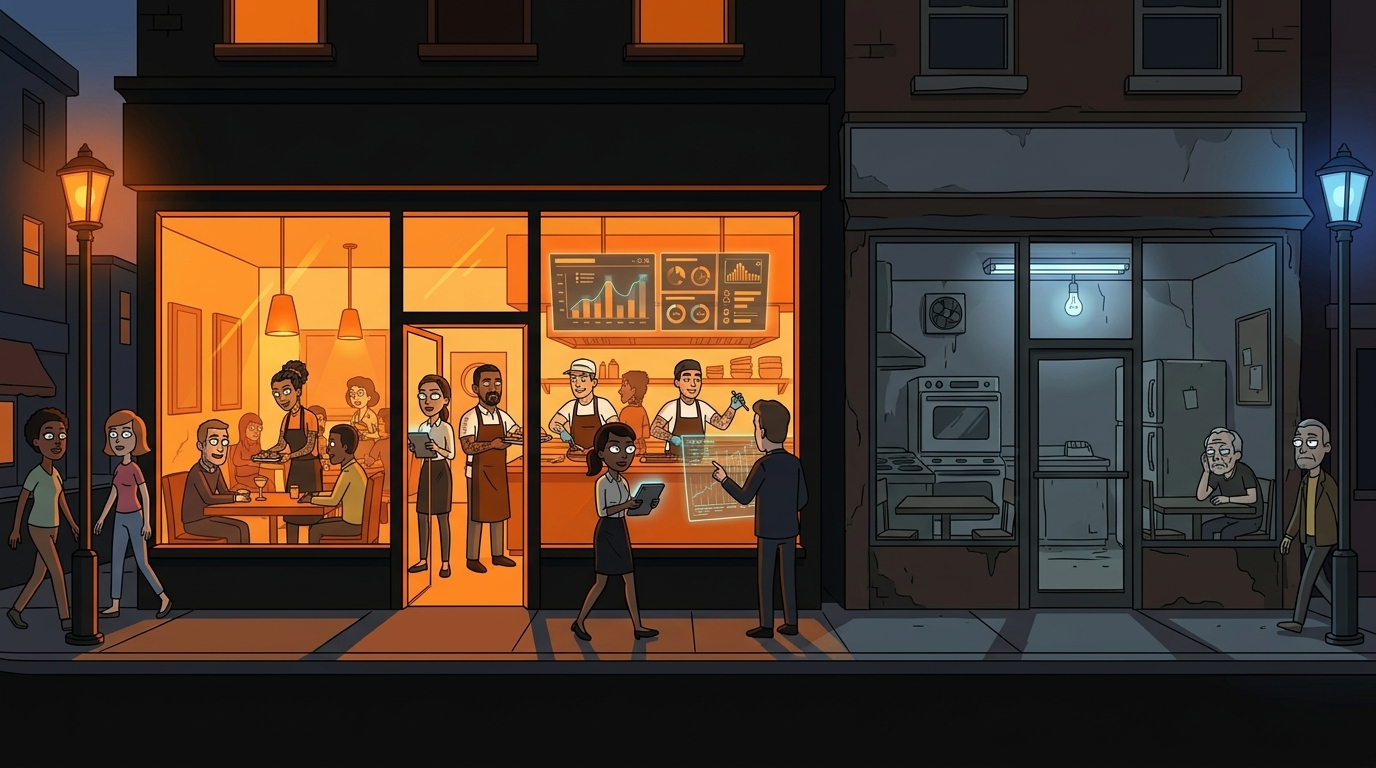
A restaurant owner told me last week that her competitor down the street seems to be thriving while she's barely breaking even. Same neighborhood, same foot traffic, similar menu. The difference isn't the food - it's the systems behind the food.
Restaurant365 just released research proving it: AI-using operators are measurably outperforming non-AI operators on profitability metrics. This isn't theory - it's showing up in actual P&Ls right now. According to their data, 87% of restaurant leaders are already investing in AI. The ones who aren't? They're watching their margins shrink while competitors pull ahead.
What Is the Restaurant Profitability Gap?
The profitability gap is the measurable difference between restaurants using AI-powered systems and those running on manual processes. It shows up in food cost percentages, labor efficiency, inventory waste, and ultimately - net profit.
Restaurant365's research identifies this as a widening divide. AI-using operators aren't just slightly ahead. They're consistently outperforming across every profitability metric that matters. When you're running a restaurant on spreadsheets and gut feel, you're competing against someone who has real-time data feeding every decision they make.
The painful part? Most restaurant owners don't even know the gap exists. They think their competitor just has better marketing or a luckier location. The real difference is invisible - it's in the 20 hours a week of admin work that one owner automated and the other is still doing by hand.
Think about it this way. You walk into your restaurant at 6 AM. The delivery truck is already late. Your prep cook called out. You've got three vendor invoices to reconcile, a schedule to fix, and a health inspection reminder you keep ignoring. That's your morning, every morning. Your competitor down the street? Their AI agent flagged the delivery delay at 5:30 AM, auto-reached two backup staff for the prep shift, and reconciled yesterday's invoices overnight. They walked in at 7 AM with coffee.
Why Is the Gap Widening in 2026?
Two things happened this year that accelerated the divide.
First, Restaurant365 launched R365 AI in May 2026 - described as "the only intelligence engine built on the full restaurant P&L." That's a big deal because it means the data isn't siloed anymore. Your food cost data talks to your labor data talks to your revenue data. For chains and multi-unit operators, this is already live and running. They're not experimenting - they're profiting from it.
Second, the tooling got accessible. Two years ago, AI for restaurants meant enterprise contracts with six-figure price tags and 12-month implementations. Now you can deploy targeted automation for specific problems - scheduling, inventory ordering, review management - without a massive upfront investment.
The operators who moved early are seeing compound returns. Every month they run better systems, the gap grows. Every month you wait, the cost of catching up increases. CrunchTime now covers the full food lifecycle across 850+ brands, 150,000+ locations, and 100+ countries. The chains figured this out. Independent operators are still running on spreadsheets and gut feel.
The adoption curve is accelerating, not slowing. What was "early adopter" behavior in 2024 is becoming table stakes in 2026. By 2027, running a restaurant without AI-assisted operations will be like running one without a POS system - technically possible, but competitively suicidal.
What AI-Using Restaurants Actually Do Differently
This isn't about robots in the kitchen or replacing your staff with algorithms. It's about the boring, invisible work that burns out restaurant owners and managers.
Automated inventory ordering. Instead of walking the cooler with a clipboard, AI tracks usage patterns and predicts what you need before you run out. It compares supplier prices in real time across multiple vendors. One restaurant owner I talked to cut food waste by 18% in the first month - not by changing the menu, just by ordering more accurately. That's thousands of dollars a year in chicken alone.
AI-driven scheduling. Your scheduling app shows who's available. An AI scheduling system shows who's available, who's likely to call out based on historical patterns, what your labor cost percentage will be before the shift starts, and whether you're about to hit overtime thresholds. It also factors in your sales forecasts - no more overstaffing on slow Tuesdays and scrambling on surprise-busy Saturdays.
Real-time food cost monitoring. Most owners check food cost monthly - after the damage is done. AI-using operators see it daily. When chicken prices spike 12%, they know within hours and adjust portions, update specials, or switch a menu item before it eats a week's worth of profit. That monthly report you're getting? It's an autopsy. Daily monitoring is preventive medicine.
Automated review responses and sentiment tracking. Not just "thanks for the review!" auto-replies. Real sentiment analysis that identifies trending issues across Google, Yelp, TripAdvisor, and Facebook simultaneously. "Three reviews this week mentioned slow service on Friday nights" is actionable data. A pile of unread Google reviews you check once a month is noise.
Admin task automation. The paperwork. The compliance logs. The temperature checks. The vendor communications. The scheduling adjustments that cascade into three more adjustments. The stuff that keeps you at the restaurant until 11 PM after a 14-hour shift. This is the work AI handles best because it's repetitive, rule-based, and nobody wants to do it.
Vendor price comparison. Your Sysco rep just sent the monthly invoice. Chicken breast is up 12%. You call your US Foods rep and he laughs. An AI system compares across all your vendors in seconds, flags the best price, and even tracks historical pricing trends so you know if this month's spike is temporary or the new normal.
How to Close the Gap Without a Tech Degree
Here's where most AI companies lose restaurant owners: they pitch a platform instead of a process. You don't need a platform. You need to know where your biggest gaps are and fix them in order of impact.
Start with an honest assessment. What are you spending the most time on? Where are you losing the most money? For most independent restaurants, the answer is one of three things: labor costs that creep up unpredictably, food waste you can't track accurately, or admin work that eats your nights and weekends.
That's exactly why we built the SWOT assessment. It takes about 10 minutes and identifies your three biggest operational gaps - ranked by impact and ease of fix. No 12-month contracts. No enterprise pricing. Just a clear picture of where you're bleeding money and what to do about it first.
The restaurant owners who are closing the gap right now didn't start by hiring a CTO or signing up for some massive platform. They started by admitting they had gaps and looking at the data honestly. Then they fixed the biggest one first, measured the result, and moved to the next one.
Here's a real-world framework that works:
- Audit your current systems. List every tool, spreadsheet, and manual process you use daily. Note how many hours each one eats per week.
- Identify the top 3 time sinks. For most owners, it's scheduling (8-12 hours/week), inventory (4-6 hours/week), and vendor management (3-5 hours/week).
- Calculate the hidden cost. Multiply those hours by what your time is actually worth. Not your hourly wage - what your strategic attention is worth to the business.
- Fix one at a time. Don't try to automate everything at once. Pick the biggest time sink, deploy a solution, measure the result, then move on.
What Happens If You Do Nothing?
Your competitors aren't waiting. Restaurant365's data shows the gap is accelerating, not stabilizing. The operators who adopt AI now are building advantages that compound monthly.
The math is brutal. If your food cost is 2 points higher than a competitor using AI-driven ordering, that's $40,000 a year on a $2 million operation. If your labor scheduling wastes 15 hours a week of manager time, that's $15,000+ annually in salary you're paying for work a system could do in minutes. If your admin tasks keep you from spending time on menu development, staff training, and customer experience - the things that actually drive repeat business - that's an opportunity cost you can't even measure.
These aren't hypothetical numbers. They're the invisible costs of running on manual systems while your competitors don't.
The restaurant that survives isn't the one with the best chef. It's the one with the best systems. If you don't know where your gaps are, that's the first problem to solve.
Take 2 minutes to see where your restaurant's biggest AI opportunities are. Free quiz at clawprime.ai/quiz. No sales pitch, no commitment - just a clear picture of what's possible and where to start.
Want to see where your restaurant stands? Take the free AI Readiness Quiz at clawprime.ai/quiz - 2 minutes, instant results.
Next step
Choose the next practical step for your restaurant.
Check your restaurant's AI readiness or use the SWOT path to identify the most useful operational opportunities.
Keep reading
Related posts
More practical guidance for restaurant operators who want less busywork and better follow-through.
Zume Spent $400M Learning That AI Without a Workflow Map Fails. Miso Just Bought the Wreckage for Pennies.
You walk into your kitchen at 6 AM. The delivery truck is late. Your prep cook called out. The new inventory system you just bought? Nobody's logged into it since Tuesday. It's sitting there, gatherin
Starbucks Scrapped Its AI Inventory Tool After 9 Months. Here's What Went Wrong.
Your barista just counted the oat milk. The system says you have 14 cartons. You actually have 3. The AI inventory tool that was supposed to save time is now creating a crisis, and nobody caught it un
Which Restaurant Voice AI Should You Buy? A Stack-First Guide for Independent Operators
For most independent restaurants, the right restaurant voice AI is the product that solves a measured call problem and works safely with the reservation, POS, ordering, and phone systems already in us