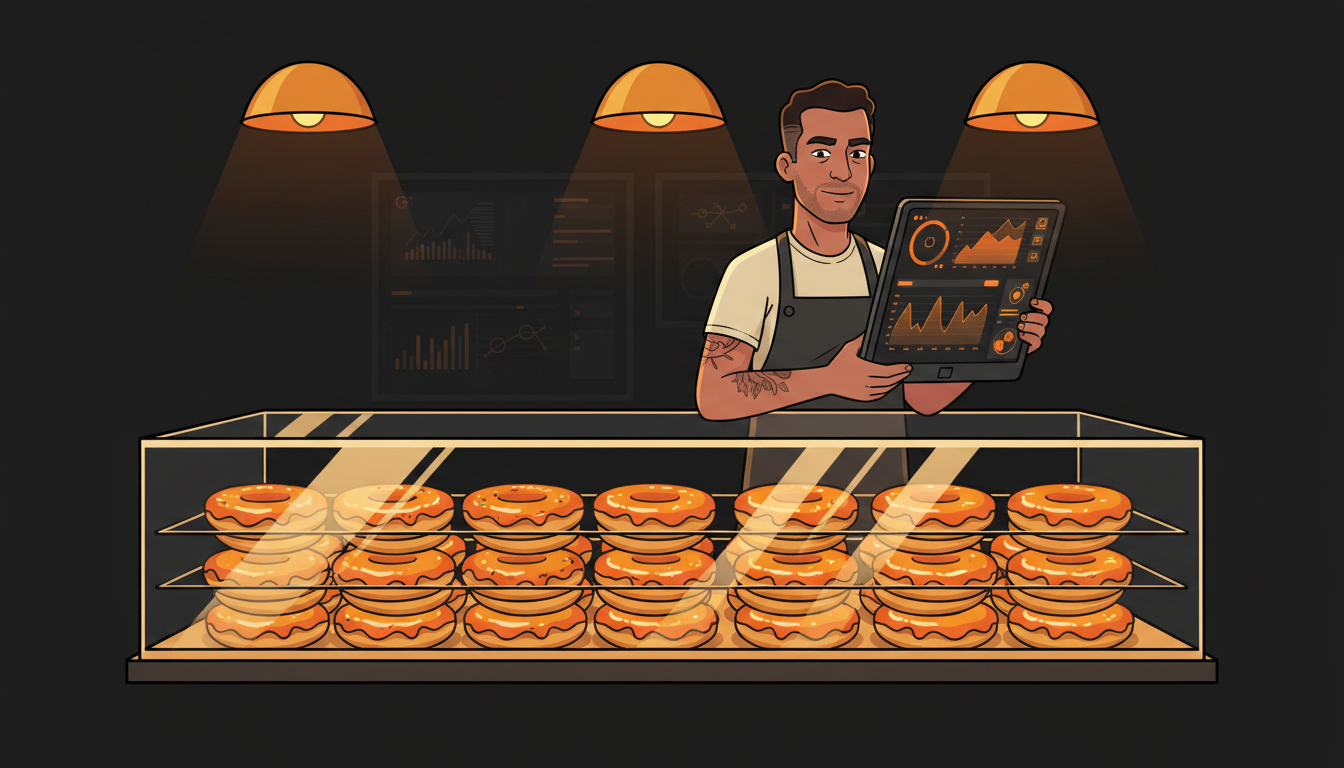
Dunkin' Is Predicting Donut Demand by the Hour. Here's What Independents Can Learn.
One Dunkin' franchisee is using AI to predict donut demand at an hour-by-hour level. They know exactly how many glazed donuts to make at 7 AM versus 10 AM versus 2 PM. Meanwhile, most independent restaurants are still doing inventory with a clipboard on Monday morning, eyeballing the walk-in, and ordering "what we always order." The AI divide isn't about who has the biggest budget — it's about whose data is connected.
According to Fast Company's 2026 reporting, this Dunkin' franchisee shifted from "order what we always order" to "order what the data says we'll sell." The franchise advantage is real — aggregate demand data across hundreds of locations gives them a training dataset that a single-location restaurant can't match. But that doesn't mean independents are locked out. The gap is data, not budget.
How Is Dunkin' Using AI to Predict Donut Demand?
The Dunkin' playbook is straightforward but powerful. They're pulling historical sales data at the item level, broken down by hour, day of week, and season. Then they layer in external signals — weather, local events, school schedules, holidays. The AI builds a demand model that predicts how many donuts each location needs at each hour of the day.
This is a massive shift from the traditional approach. Most restaurants order based on three things: what they ordered last week, what the kitchen manager's gut says, and a safety buffer "just in case." That safety buffer is where the waste lives. You order 20% more than you need because running out feels worse than throwing food away. Over a year, that 20% buffer on perishable items adds up to thousands of dollars in the trash.
Dunkin' eliminated the buffer by making the prediction accurate enough to trust. When the AI says you need 47 glazed donuts at 7 AM and 23 at 10 AM, and the actual numbers come within 5% of that, the manager stops ordering the safety stock. Waste drops. Food cost drops. And the donuts are fresher because they're made closer to when they're actually sold.
Why Can't Independents Just Copy the Dunkin' Model?
The honest answer: single-location operators have thinner data sets. Dunkin' has hundreds of locations generating millions of data points. A single-location restaurant has one POS, one kitchen, one set of sales patterns. Training a demand prediction model on that limited data is harder.
Two-thirds of restaurant operators think AI could help their business, according to SmartCompany's January 2025 survey. But adoption lags behind intent. The gap isn't willingness — it's data infrastructure. Most independents don't have their historical sales data organized in a way that AI can consume. It's locked inside their POS, exported as CSV files nobody looks at, or scattered across three different systems that don't talk to each other.
Then there's the legacy POS problem. Our research found that 75,000 to 100,000 restaurant locations still run on Aloha POS, and over 100,000 run on Micros. These systems were built in an era before API-first architecture. Getting data out of them is possible but clunky. And if your data is hard to get, your AI is hard to build.
The franchise model also gives Dunkin' another advantage: standardized menus. When every location sells the same 30 items, the demand model transfers easily across locations. An independent restaurant with a seasonal menu, daily specials, and a chef who "feels like" making a new dish today introduces variability that's harder to model.
What Actually Works for Independent Restaurant Inventory Prediction?
The key for independents isn't more data — it's connected data. A single-location restaurant with a POS, an inventory system, and access to weather and local event data has more predictive power than most owners realize. The problem is that those three data sources are sitting in separate systems that don't talk.
Here's what connected data looks like in practice. Your POS tells you that last Thursday you sold 42 burgers between 6 PM and 9 PM. Your inventory system tells you that you used 84 burger patties (two per burger) and ran out of brioche buns by 8:30. The weather forecast says this Thursday will be 10 degrees warmer and sunny. The local event calendar shows a concert at the venue three blocks away at 7 PM.
Connected, that data tells you: you'll probably sell 50 to 55 burgers this Thursday, you need 110 patties and 60 brioche buns, and you should prep an extra batch of fries because the concert crowd will spike your bar tab orders. That's not AI magic — it's just data that's already in your systems, connected and visible.
The tools that make this possible don't require you to replace your POS. They sit on top of it. They pull sales data from your existing system, combine it with inventory counts and external signals, and give you a prep list that's based on predicted demand rather than "what we always make."
What Is the First Step to Connecting Your Inventory Data?
Before you buy a predictive ordering tool, you need to connect your existing data sources. Here's the minimum viable data set for restaurant inventory prediction:
POS sales data by item, day, and time. Pull a 90-day export from your POS. If your system can't do this, that's your first problem — and it's worth fixing before anything else. You need to know what you sold, when you sold it, and in what combinations.
Inventory counts by category. You don't need a perfect count of every item. You need categories: proteins, produce, dairy, dry goods, beverages. Weekly counts at minimum. If you're doing counts monthly, you're flying blind for three weeks out of four.
Waste tracking. This is where most restaurants have zero data. Start simple: a clipboard by the back door where the kitchen manager writes down what got thrown away and why. Spoilage, over-prep, plate waste, kitchen errors. Two weeks of honest waste tracking tells you more about your food cost than any AI tool.
External signals. Weather forecasts, local event calendars, school schedules, holidays. These are free and publicly available. The correlation between a sunny Friday and a 30% spike in patio traffic is obvious once you see the data — but invisible if you're not looking.
Once you have these four data sources, you can start building a demand model. It doesn't need to be sophisticated. A spreadsheet that matches predicted covers to prep quantities, adjusted by day of week and weather, beats the "what we always order" approach by a wide margin.
What Happens After You Start Predicting Instead of Guessing?
The first thing operators notice is waste dropping. When your prep list matches predicted demand instead of gut instinct, you stop over-prepping. The industry average is that 4 to 10% of food purchased gets thrown away. For a mid-size restaurant doing $15K a week in food sales, that's $25,000 to $75,000 a year walking out the back door. Predictive ordering cuts that number significantly — not to zero, but to a fraction of what it was.
The second thing is consistency. Your guests expect the same quality every time they visit. When you're guessing on prep, you're either over-prepping (waste) or under-prepping (86'd items and disappointed guests). Predictive ordering gives you the data to hit the sweet spot more often.
The third thing is confidence. When the kitchen manager walks in on Saturday morning and sees a prep list based on predicted sales, weather, and local events, they stop guessing. They know what to prep, how much to prep, and when to prep it. That confidence shows up in food quality, ticket times, and staff morale.
Dunkin' has the franchise advantage, but independents have something Dunkin' doesn't: flexibility. You can adjust your menu, your prep, and your ordering in ways a franchise can't. That flexibility, combined with connected data, is a competitive advantage — if you use it.
Want to See Where Your Inventory Data Is Leaking?
If you're curious where your restaurant's biggest inventory and food cost opportunities are, our AI SWOT Assessment digs into every layer of your operation — POS, inventory, vendor ordering, prep workflows — and gives you a concrete roadmap for getting your data connected and your food cost under control.
You can also take our free AI Readiness Quiz — it takes 2 minutes and shows you exactly where your restaurant has the biggest gaps in data visibility and automation.
Next step
Choose the next practical step for your restaurant.
Check your restaurant's AI readiness or use the SWOT path to identify the most useful operational opportunities.
Keep reading
Related posts
More practical guidance for restaurant operators who want less busywork and better follow-through.
How to Use AI to Handle Shift Call-Outs Without Manager Scrambling
It's 10 AM on a Saturday. Your 6 PM line cook just texted "can't make it." You have 8 hours and 30 contacts to call. Here's how an AI agent handles this in under 2 minutes - without you touching your
How to Build an AI Layer on Top of Toast POS
Your Toast POS captures every transaction, every labor hour, every menu item sold. It gives you charts. What it doesn't give you is a recommendation. Here's how to build the layer that turns your data
How to Use AI to Detect Overtime Before It Happens in Your Restaurant
You just ran payroll. Three servers hit overtime last week. One racked up 12 hours of time-and-a-half. You didn't know until the damage was already done.