The Real Cost of Manual Scheduling: A Restaurant Owner's Calculator
RestaurantNews just dropped a number that should make every owner uncomfortable: 10-15 hours per week lost on scheduling. That's not a rounding error. That's a part-time employee you're paying to shuffle spreadsheets.
You know the drill. Monday morning, the manager sits down with last week's schedule, a stack of availability notes, three text messages about shift swaps, and the knowledge that two people requested off for the same Saturday. Two hours later, the schedule is done. Except it's not done, because at 4 PM someone texts that they can't work Thursday and the whole thing unravels.
38% of restaurant managers say scheduling is their number one administrative headache, according to a 2026 Harri survey. Not inventory. Not vendor management. Not health inspections. Scheduling. The thing that happens every single week and never gets easier.
What Does Manual Scheduling Actually Cost You?
The cost of scheduling isn't just the 4-6 hours building the schedule. It's everything that surrounds it. Let's break it down honestly.
Building the schedule: 4-6 hours/week. This is the obvious cost. The manager pulls up the template, checks availability, balances labor costs against expected volume, and writes the schedule. Most managers do this in one sitting, usually on their day off or between other tasks.
Text chain management: 2-3 hours/week. "Who can cover my shift?" "Can I swap Saturday for Sunday?" "I have a doctor's appointment Tuesday." Each text requires a response, a check against the schedule, a confirmation from the other person, and an update to the schedule. Multiply by 15-20 employees.
Shift swap mediation: 1-2 hours/week. When two people want to swap but one is already at overtime, or the swap creates a coverage gap, the manager has to negotiate. This is the part nobody counts because it happens in 5-minute increments throughout the week.
No-show management: 1-2 hours/week. Someone doesn't show up. The manager calls, texts, scrambles to find a replacement, and adjusts the floor plan. This is reactive scheduling, and it's the most stressful kind because it happens during service.
Overtime calculation: 30 minutes/week. Tracking who's approaching 40 hours, who can safely pick up extra shifts, and who's already in overtime territory. Get this wrong and you're paying time-and-a-half when you didn't need to.
Total: 10-15 hours per week. At a $25/hour manager rate, that's $250-375 per week. $13,000-19,500 per year. For one manager at one location. Multi-location operators multiply that by each site.
What Are the Hidden Costs Beyond Time?
Time is the visible cost. The hidden costs are worse.
Overstaffing on slow days. Without predictive scheduling, managers staff for the average Tuesday. Some Tuesdays are dead. You're paying two servers to stand around. That's $200-300 in wasted labor on a single shift.
Understaffing on busy days. The reverse happens too. A surprise nice day, a local event, a viral social media post. Your Saturday is slammed and you're short one cook. Service slows, reviews suffer, and the kitchen burns out.
Overtime that shouldn't have happened. Manual scheduling doesn't flag when someone's at 38 hours and you just scheduled them for a 6-hour Saturday. Time-and-a-half for 2 hours costs you an extra $25. Multiply by a few employees per week.
Turnover from schedule frustration. The number one reason hourly restaurant workers quit isn't pay. It's scheduling. Unpredictable schedules, denied time-off requests, and last-minute changes push good employees out the door. The National Restaurant Association estimates turnover costs $6,109 per employee. One bad scheduling decision can cost you a good server.
Compliance violations. Some cities and states have predictive scheduling laws (San Francisco, New York, Oregon, Chicago). Violations can trigger penalties of $50-500 per incident. Manual scheduling makes compliance nearly impossible to prove.
How to Calculate Your Restaurant's Scheduling Cost
Here's a simple calculator you can run right now. Grab a piece of paper or open a spreadsheet.
Step 1: Count the hours. Track every hour your manager spends on scheduling-related tasks for one week. Include building the schedule, responding to texts, mediating swaps, handling no-shows, and calculating overtime. Be honest. The number is usually higher than you think.
Step 2: Multiply by the hourly rate. Your manager's fully loaded rate (base + benefits + payroll taxes). If they make $20/hour, their loaded rate is probably $24-26. Use $25 as a conservative estimate.
Step 3: Add error costs. Estimate how much you lose per week to overstaffing, understaffing, and overtime errors. A rough guide: if your labor cost runs 1-2% above target on average, that's $500-1,000 per week on a $50,000/week revenue operation.
Step 4: Add turnover cost. If you've lost even one employee in the past year due to scheduling frustration, divide that $6,109 turnover cost by 52 weeks. That's $117/week in scheduling-driven turnover.
Step 5: Add compliance risk. If you're in a jurisdiction with predictive scheduling laws, estimate your exposure. One violation per week at $100 each = $5,200/year.
The Scheduling Tools That Actually Work
Three platforms dominate AI-driven restaurant scheduling: 7shifts, HotSchedules (Fourth), and When I Work. Each has a different strength.
7shifts is the most popular among independent restaurants. It integrates with 30+ POS systems, uses historical sales data to predict labor needs, and has a mobile app that employees actually use. Pricing starts at $30-50/month per location for the features you need.
HotSchedules (Fourth) leans toward larger operations and multi-unit groups. Stronger on compliance tracking and labor cost forecasting. Pricing is higher, typically $2-4 per employee per month.
When I Work is the simplest option. Good for single-location restaurants that want basic scheduling with shift swapping. Starts at $4/employee/month.
All three have APIs, which means they can connect to other systems (POS, inventory, payroll) for cross-platform intelligence. The tool itself is valuable. The integrations make it powerful.
What Happens After You Automate Scheduling?
The pattern is consistent across restaurants that switch from manual to AI scheduling.
The math is simple. 10-15 hours per week at $25/hour = $250-375/week in manager time. An AI scheduling tool costs $50-150/month. Break-even happens in 2-3 weeks. Everything after that is profit.
The scheduling group text with 47 unread messages at 6 AM on a Saturday. The spreadsheet called "Schedule FINAL v2 FINAL REAL.xlsx." The 15 minutes mediating a shift swap while the dinner rush starts. That's not running a restaurant. That's babysitting a calendar. AI fixes the calendar so you can run the restaurant.
Want us to find your scheduling blind spots? We do a full SWOT assessment for restaurants - $297, and we'll show you exactly where you're bleeding money.
Next step
Choose the next practical step for your restaurant.
Check your restaurant's AI readiness or use the SWOT path to identify the most useful operational opportunities.
Keep reading
Related posts
More practical guidance for restaurant operators who want less busywork and better follow-through.
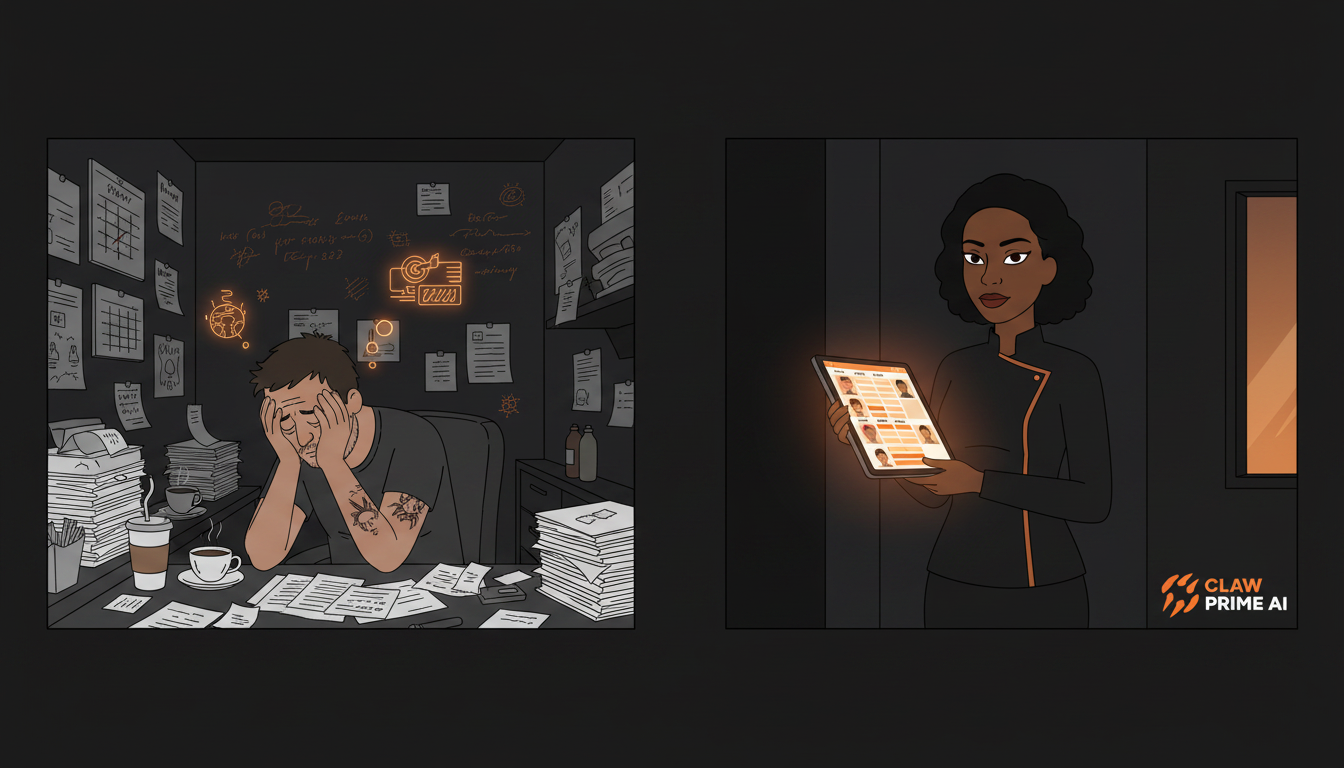
How to Automate Staff Scheduling with AI
Your manager spends 4-6 hours a week building schedules that still end up wrong. Here's how AI builds better schedules in 10 minutes using your existing tools and POS data.
Which Restaurant Voice AI Should You Buy? A Stack-First Guide for Independent Operators
For most independent restaurants, the right restaurant voice AI is the product that solves a measured call problem and works safely with the reservation, POS, ordering, and phone systems already in us
How to Use AI to Handle Shift Call-Outs Without Manager Scrambling
It's 10 AM on a Saturday. Your 6 PM line cook just texted "can't make it." You have 8 hours and 30 contacts to call. Here's how an AI agent handles this in under 2 minutes - without you touching your