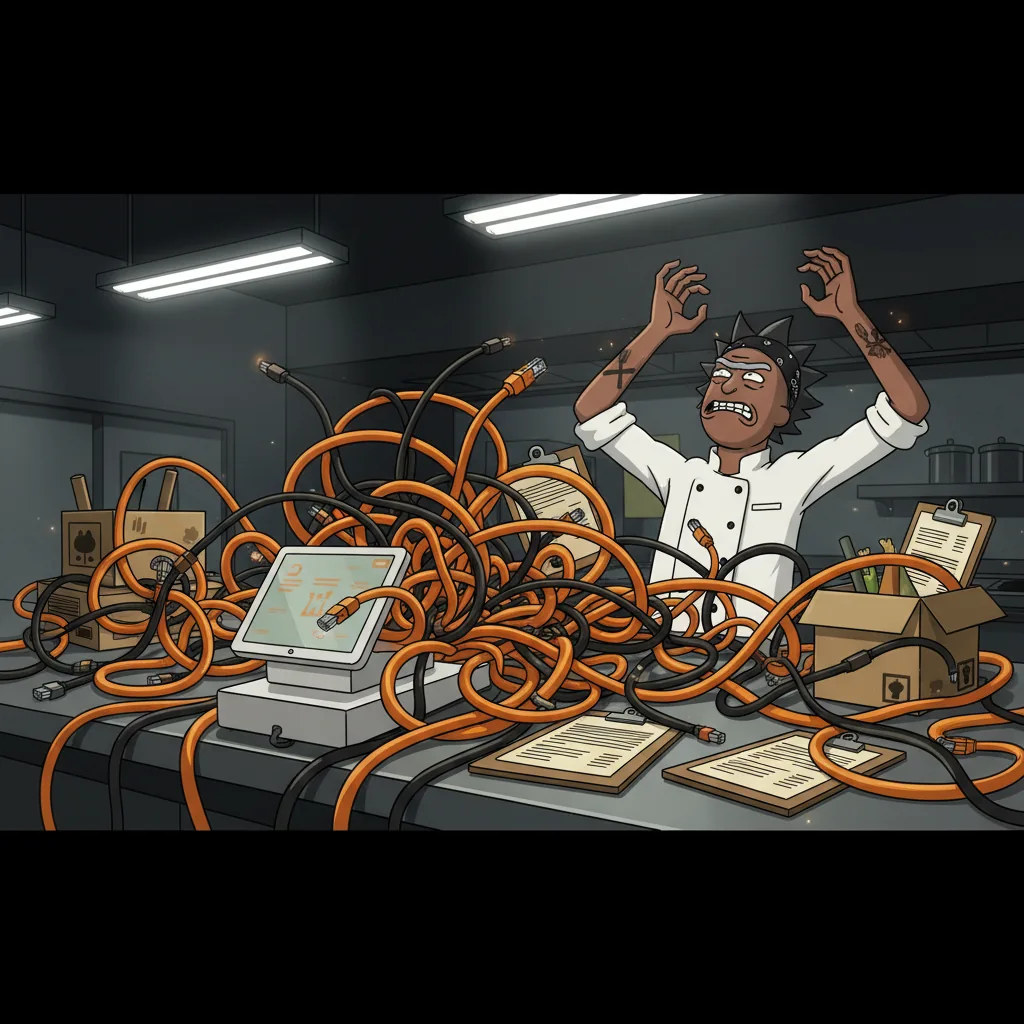
The Fragmentation Tax: Why Your Restaurant's 12-Tool Tech Stack Is Bleeding Money
Your POS sees revenue but misses who made the food and how long it took. Your scheduling system knows labor costs but can't see sales. Your inventory tracker counts what's on the shelf but has no idea what's selling. Your vendor ordering platform has no clue what you 86'd last week. Each one works fine in its own little world. None of them talk to each other. That's the fragmentation tax — and every restaurant with more than three disconnected tools is paying it.
According to RTN's coverage of the 2026 NRA Show, "many restaurant executives are arriving at this year's NRA Show carrying the scars of those decisions — overlapping vendor relationships, duplicate data entry, inconsistent reporting, integration failures, escalating SaaS costs." The restaurant tech gold rush that started five years ago has left operators buried under a pile of tools that each do one thing well and nothing together. The bill comes due every week, and it's bigger than most owners realize.
What Did the NRA Show Floor Actually Tell Us About Restaurant Tech?
The headline theme at NRA Show 2026 was "simplification." Not "more AI." Not "next-generation dashboards." Operators want fewer tools that do more, not more tools that do less.
The shift was visible on the floor. Vendors who led with "we're an AI company" got polite nods. Vendors who said "we replace three of your current tools and connect to everything else" got real conversations. Operators are done adding dashboards. They want consolidation.
This is a direct response to the past five years. Between 2020 and 2025, restaurants added tools at a frantic pace. Online ordering during COVID. Contactless payments. Digital scheduling. Inventory tracking. Review management. Tip pooling. Each one solved an immediate problem. None of them were chosen with integration in mind.
Now those operators are paying the fragmentation tax. RTN reported that "technology spending increasingly requires the same scrutiny as any other capital investment." The days of signing up for another $99/month SaaS tool because it solves one problem are over. Every new tool needs to justify itself against the cost of the stack it's joining.
How Much Is the Fragmentation Tax Costing Your Restaurant?
The fragmentation tax shows up in four places, and most operators only notice one of them.
Duplicate data entry. Your manager spends 20 minutes every morning copying sales data from the POS into the inventory system. Your prep cook enters waste numbers into a spreadsheet that nobody looks at. Your bookkeeper manually reconciles vendor invoices against purchase orders. That's 5 to 10 hours a week of labor doing work that should be automatic. At $18 to $25 an hour, that's $90 to $250 a week — $4,700 to $13,000 a year — spent on data entry that a connected system eliminates.
Integration failures that create blind spots. Your scheduling tool doesn't know about the concert happening three blocks away on Friday. Your inventory system doesn't know you 86'd the salmon on Tuesday. Your POS doesn't know your best line cook quit last week. Each blind spot costs money — in over-staffing, under-prepping, or missed upsells. Anecdotally, operators report $200 to $800 a week in recoverable dollars hiding in these gaps.
Escalating SaaS costs. Eight tools at $79 to $149 a month adds up fast. A mid-size restaurant running POS ($149), scheduling ($99), inventory ($129), vendor ordering ($89), review management ($79), tip pooling ($59), online ordering ($99), and accounting integration ($79) is spending $782 a month — $9,384 a year — on software. And that's before you add a "AI tool" on top of all of it.
Cognitive load. This is the cost nobody quantifies but everyone feels. Your manager checks four apps before making one scheduling decision. You log into three systems to figure out your food cost. Your bookkeeper reconciles five different data sources at the end of the month. The mental overhead of managing a fragmented stack is exhausting, and it pulls attention away from the things that actually grow the business — like cooking great food and keeping guests happy.
What Does Tech Consolidation Actually Look Like for Restaurants?
Consolidation doesn't mean throwing everything out and starting over. For most restaurants, that's not realistic — you've got contracts, staff trained on specific tools, and data locked inside systems you've been using for years.
The real question operators are asking at shows and in forums is: "How quickly can this system be implemented? Does it integrate cleanly with the existing POS infrastructure? Will staff actually use it?" Those three questions filter out 80% of the tools on the market.
The consolidation trend is moving in two directions. First, larger platform providers with broad integration capabilities are gaining ground. They offer scheduling, inventory, labor management, and analytics under one roof. The downside: you're locked into their ecosystem, and if one module falls behind the market, you're stuck.
Second, a new category of "integration layers" is emerging. These tools sit on top of your existing systems and make them talk to each other. They don't replace your POS or your scheduling tool — they connect them. Your inventory data flows into your scheduling decisions. Your sales data flows into your ordering predictions. Your labor costs become visible next to your revenue in real time.
The second approach is what we believe works best for independents. You've already invested in tools your staff knows. Throwing that away because a new platform promises "all-in-one" is risky. Making your existing tools work together is the smarter play.
Why Does Platform-Agnostic AI Beat the All-in-One Approach?
Here's the problem with all-in-one restaurant platforms: they're only as good as their weakest module. Maybe their POS is excellent but their inventory tracking is basic. Maybe their scheduling is strong but their vendor ordering is clunky. You end up using their best features and suffering through the rest.
Platform-agnostic AI flips that model. Instead of replacing your stack, it sits on top and connects everything. Your Square POS talks to your 7shifts scheduling. Your MarketMan inventory talks to your Sysco ordering. The AI sees all of it and makes decisions based on the full picture.
This matters because the value of AI isn't in the algorithm — it's in the data. An AI that only sees your POS data can tell you what sold. An AI that sees your POS data, your labor data, your inventory data, and your vendor pricing can tell you what sold, what it actually cost, who made it, how long it took, and whether you should order more of the ingredients next week. That's the difference between a dashboard and an intelligence layer.
RTN's NRA Show reporting noted that "handheld POS is now viewed as operational infrastructure that materially improves throughput, reduces payment friction, and helps servers manage larger sections during labor shortages." The tools that win are the ones that integrate into existing workflows, not the ones that demand new ones.
What Happens After You Start Consolidating?
The first thing operators notice after connecting their systems is visibility. You can suddenly see your food cost as a percentage of sales in real time — not three weeks later when the P&L comes back. You can see labor cost next to revenue by shift, not just as a monthly total. You can see which menu items are profitable and which are bleeding money, with the full cost picture including labor and waste.
The second thing is time. Managers who spent 5 to 10 hours a week on data entry and cross-referencing get that time back. They spend it on the floor, with guests, training staff, fixing problems before they become crises.
The third thing is money. When your systems connect, the blind spots close. That $200 to $800 a week in recoverable dollars starts showing up. Food cost drops 2 to 4 points. Labor scheduling gets tighter. Vendor pricing changes get caught before they hit the P&L.
The fragmentation tax is real, and it's expensive. But it's also fixable. You don't need more tools — you need the tools you have to actually work together.
Want to See Where Your Integration Gaps Are?
If you're running more than three disconnected tools and wondering where the money is leaking, take our free AI Readiness Quiz. It takes 2 minutes and maps exactly where your restaurant's biggest integration gaps are — and where AI can help close them.
We built this quiz after seeing the same pattern in restaurant after restaurant: great tools, terrible integration, and an owner who knows something's wrong but can't see the full picture. The quiz shows you the picture.
If you want the full diagnostic, our AI SWOT Assessment digs into every layer of your operation — POS, scheduling, inventory, vendor management, labor — and gives you a concrete roadmap for consolidation.
Next step
Choose the next practical step for your restaurant.
Check your restaurant's AI readiness or use the SWOT path to identify the most useful operational opportunities.
Keep reading
Related posts
More practical guidance for restaurant operators who want less busywork and better follow-through.
Is AI Replacing Empathy in Restaurants? The Line Your Tech Can't Cross
62% of customers accept back-of-house AI but resist front-of-house automation. Here's where the line is and how to find your balance.
Square vs Toast: Which POS is Right for Your Restaurant in 2026?
Square or Toast? Every restaurant owner asks this. Here's what actually matters in 2026 - pricing, features, pain points, and the third option nobody mentions.
Pizza Hut's AI Delivery System Just Triggered a $100M Lawsuit. Here's What Went Wrong.
Pizza Hut's AI routing system was supposed to get food to customers faster. Instead, delivery times jumped from under 30 minutes to over 45. Drivers figured out how to game the algorithm.