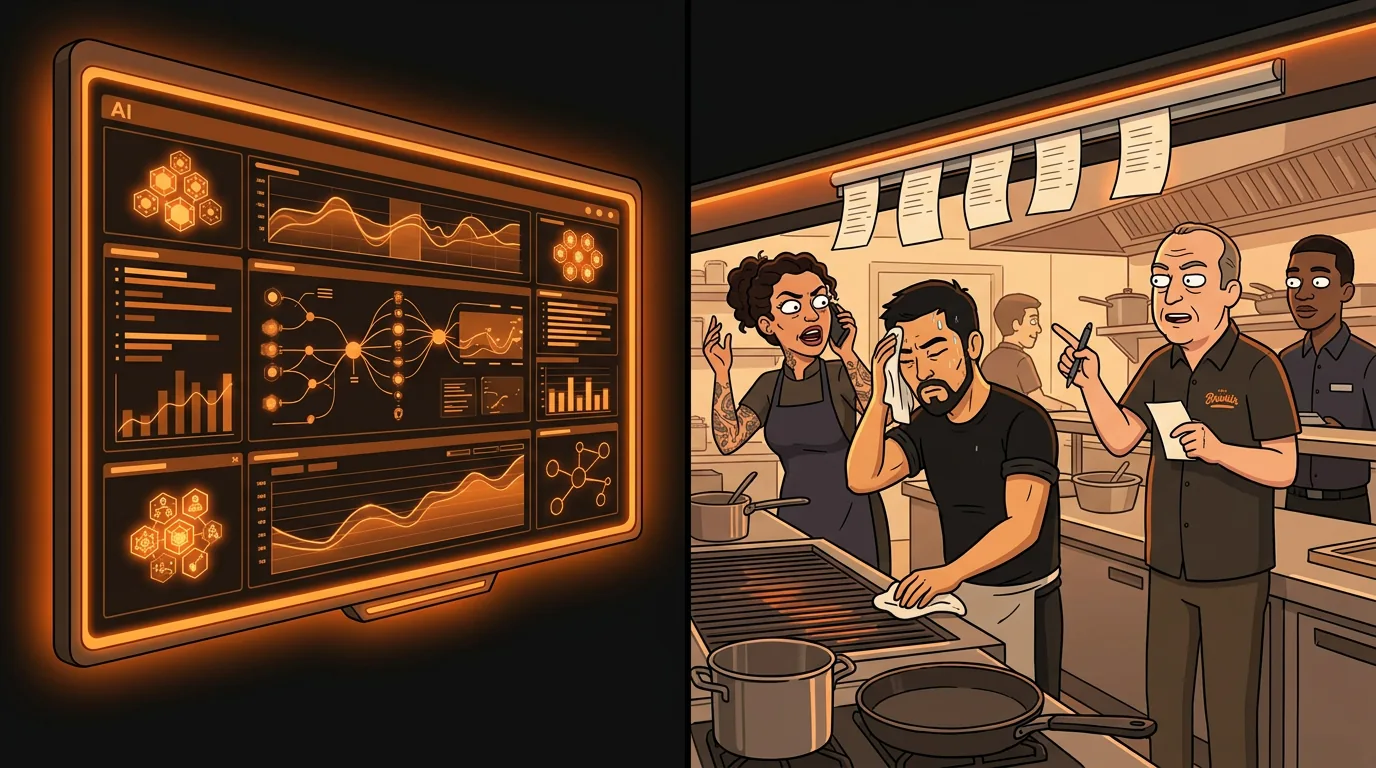
The Real Reason Restaurant AI ROI Is Lagging (It's Not the Technology)
Restaurant Business just published a piece that should make every AI vendor uncomfortable: "AI has arrived in restaurants, but ROI is lagging." They're right about the problem. But they're blaming the wrong thing.
The technology works. The problem is that most restaurants bought the wrong tool for the wrong problem, and nobody measured whether it was actually saving money.
What Does the Data Actually Show About Restaurant AI ROI?
69% of restaurant leaders say they're investing in AI, according to the National Restaurant Association's April 2026 data. That number sounds impressive until you ask the follow-up question: how many of them can point to specific, measurable savings?
Most can't.
Restaurant Business reported on June 10, 2026 that AI adoption is climbing but the returns aren't following. Restaurants are spending money on AI tools and not seeing the payoff. The article frames this as a technology problem - the tools aren't good enough yet.
That framing is wrong. The tools are fine. The strategy is the problem.
Here's what I see when I read restaurant tech breakdowns: three different tools doing the work of one, two forgotten subscriptions nobody cancelled, and zero measurement of whether any of it is actually saving time or money. A restaurant owner told me last month they were paying for an AI scheduling tool, an AI inventory tool, and an AI chatbot - and they couldn't tell me how much time any of them saved.
That's not a technology failure. That's a buying failure.
The Vitamin vs. Painkiller Problem
Most restaurant AI tools are vitamins. They sound good. They feel productive. They make you think you're being forward-thinking. But they're hard to measure, and when budgets get tight, they're the first thing to go.
The tools that actually deliver ROI are painkillers. They solve specific, expensive problems that you can put a dollar amount on.
- A scheduling tool that saves your manager 15 hours a week and you can see it on the timesheet
- An inventory system that cuts food waste by 30% and you can see it in your food cost reports
- An invoice processor that catches $340 overcharges on chicken breast before you pay them
- An "AI-powered insights dashboard" that shows you data you already had
- A "smart recommendations engine" that tells you to promote your best-selling items
- A "predictive analytics platform" that needs 6 months of data before it tells you anything useful
If your restaurant is paying $200 a month for an AI tool and you can't point to specific savings it generated, you bought a vitamin. That's the ROI gap Restaurant Business is writing about.
Why Can't Most AI Tools Prove Their Value in 48 Hours?
I've read over 200 restaurant tech breakdowns at this point. The pattern is always the same: impressive demo, confusing onboarding, vague results.
Here's my rule: if you can't measure the impact of an AI tool within 48 hours of turning it on, you bought a vitamin. Real painkillers show results immediately.
When you set up scheduling automation, you see fewer missed shifts in the first week. When you deploy inventory tracking, you see waste numbers drop in the first month. When you add invoice processing, you catch overcharges on the first invoice.
But a lot of restaurant AI tools don't work like that. They need data. They need time to "learn your patterns." They need you to trust the process. And six months later, you're still waiting for the ROI to materialize while the subscription keeps charging your card.
The 48-hour test separates real tools from expensive dashboards. If the vendor can't tell you exactly what metric will change and when you'll see it, keep your money.
Restaurants using AI for inventory management cut food waste by 30-40%, according to industry research. That's a real number. But the key word is "inventory management" - a specific, measurable problem with a specific, measurable solution. Not "AI-powered restaurant intelligence." Not "machine learning-driven insights." A tool that tracks what you throw away and tells you to order less of it.
How Do You Pick AI Tools That Actually Deliver ROI?
Stop starting with "what AI tools exist." Start with "what's costing me the most money right now."
Walk through your restaurant on a Wednesday night and count the pain points. Your manager is spending 4 hours on schedules. Your kitchen is throwing away $400 in produce every week. Your phone rings 40 times during lunch with the same five questions. Your invoices sit unentered for three days.
Those are specific problems with dollar amounts attached. Each one has an AI tool that solves it. But you have to know the problem before you can pick the tool.
Here's the framework we use in our SWOT assessment:
Step 1: Map your three most expensive problems. Not "efficiency" or "operations" - actual dollar amounts. How much is scheduling chaos costing you in overtime? How much food are you throwing away? How many hours does your manager spend on tasks that could be automated?
Step 2: Find tools that solve THOSE specific problems. Don't browse AI tool directories. Search for solutions to your exact pain points. "AI scheduling for restaurants" not "restaurant AI platform."
Step 3: Demand a measurable timeline. Ask the vendor: "What metric changes, by how much, and when?" If they can't answer, move on.
Step 4: Test for 30 days with real measurement. Track the metric before and after. Not vibes. Numbers. If the tool doesn't move the needle in 30 days, it's not going to move it in 6 months.
This approach is why we built the SWOT assessment the way we did. We don't sell AI tools. We map your operation, identify the expensive problems, and recommend specific solutions for each one. No guesswork. No vitamin subscriptions.
What Happens After You Fix Your AI Strategy?
Once you stop buying vitamins and start buying painkillers, the math changes fast.
A restaurant with two locations spending $800/month on three AI tools that don't save measurable money could redirect that budget to one tool that cuts food waste by 30%. At a $15,000 weekly food cost, that's $4,500 saved per week. In a month, the tool pays for itself 5 times over.
The difference isn't spending more on AI. It's spending on the right AI. Most restaurants that fix their strategy don't add tools - they subtract them. They cancel the two subscriptions that weren't delivering and double down on the one that was.
That's the real ROI breakthrough. Not better technology. Better decisions about which technology to use.
What Should You Do Next?
Restaurant Business is right that AI ROI is lagging. But the fix isn't better technology. It's better strategy. Map your problems first. Buy tools second. Measure everything.
If you want us to do this analysis for your restaurant, we offer a full SWOT assessment at clawprime.ai/pricing. 48-hour turnaround, concrete recommendations tied to your specific operation. We'll tell you exactly which problems are worth solving and which tools actually solve them.
Next step
Choose the next practical step for your restaurant.
Check your restaurant's AI readiness or use the SWOT path to identify the most useful operational opportunities.
Keep reading
Related posts
More practical guidance for restaurant operators who want less busywork and better follow-through.
Is AI Replacing Empathy in Restaurants? The Line Your Tech Can't Cross
62% of customers accept back-of-house AI but resist front-of-house automation. Here's where the line is and how to find your balance.
Square vs Toast: Which POS is Right for Your Restaurant in 2026?
Square or Toast? Every restaurant owner asks this. Here's what actually matters in 2026 - pricing, features, pain points, and the third option nobody mentions.
Pizza Hut's AI Delivery System Just Triggered a $100M Lawsuit. Here's What Went Wrong.
Pizza Hut's AI routing system was supposed to get food to customers faster. Instead, delivery times jumped from under 30 minutes to over 45. Drivers figured out how to game the algorithm.