The "AI Replaces Workers" Narrative Is Dead. Here's What's Replacing It.
Your kitchen manager just quit. Not because of the pay, though that's part of it. Not because of the hours, though 60-hour weeks don't help. She quit because she spends more time on scheduling spreadsheets and compliance paperwork than actually managing the kitchen. The job description said "kitchen manager." The reality is "spreadsheet operator who also cooks."
That's the real labor crisis in restaurants. Not a shortage of people - a shortage of time for the people you already have.
The Narrative Shift That Nobody Predicted
Something changed in the first half of 2026. The "AI will replace your workers" pitch stopped working.
NBC Boston profiled a new restaurant AI platform in June that explicitly positions itself as a staff-support tool, not a worker replacement. The company's entire marketing is built around one idea: give your existing team back the hours they waste on admin work. Not fewer people. Better people with more time. (Source: NBC Boston, June 18, 2026)
Restaurant tech executives are actively warning against AI overdependence. In May 2026, Restaurant Dive published a piece where multiple tech leaders said the same thing: automation that replaces humans fails, automation that supports humans succeeds. (Source: Restaurant Dive, May 26, 2026)
This isn't a marketing pivot. It's pattern recognition. Every "AI replaces workers" deployment that made headlines over the past three years ended the same way: failure, reversal, and a very expensive lesson. The market is settling on what works, and what works is augmentation.
Why "Replace Workers" Always Fails
The pattern is so consistent it's almost boring to repeat. But owners keep falling for it, so here it is one more time.
Starbucks built an AI inventory management tool. The promise was simple: automate inventory counting and ordering so staff didn't have to. Nine months later, they scrapped it. Not because the technology didn't work - because the workflow it was supposed to replace was more complex than anyone modeled. Staff judgment about what to order based on weather, local events, and supplier quirks couldn't be automated. (Source: covered in our June 24 blog)
Pizza Hut experimented with delivery automation. The idea was to reduce driver costs by automating route optimization and dispatch. The technology optimized routes beautifully. What it couldn't handle was the customer who calls after ordering to change their address, the apartment building with no buzzer, or the dog that blocks the driveway. Humans handle ambiguity. Automation handles repetition.
The pattern repeats at every scale: replace humans in complex tasks, the tool fails because it can't handle the exceptions that happen 20% of the time but consume 80% of the effort. Humans come back. Owner is out six months of subscription fees and staff goodwill.
Here's why it keeps happening. Vendors sell "automation" and owners hear "I need fewer people." But the tasks that eat the most time in a restaurant aren't the ones that can be fully automated. They're the ones that need human judgment backed by better information.
What "Augment" Actually Looks Like in Practice
Augmentation isn't a softer version of replacement. It's a fundamentally different approach to the same problem. Here's what it looks like across the three biggest time sinks in restaurant operations.
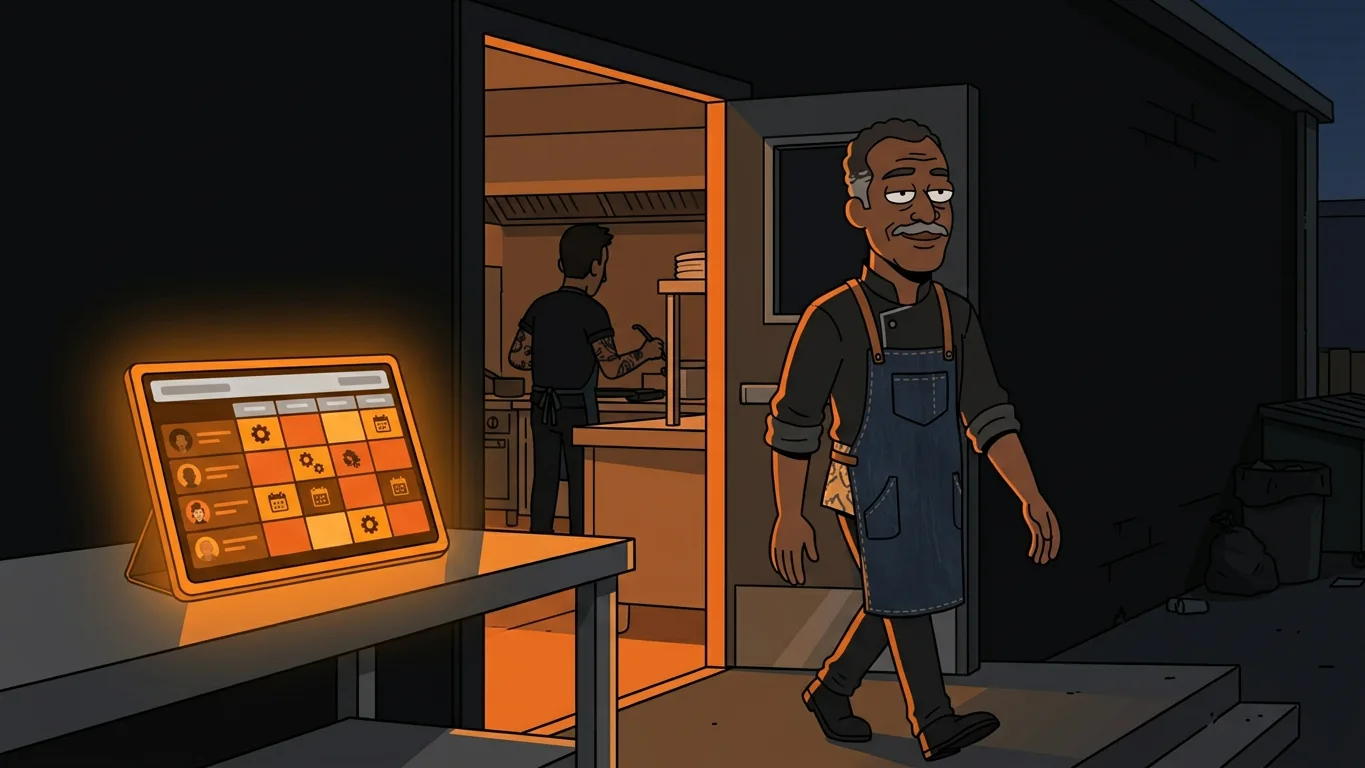
Scheduling. The old approach: AI creates schedules automatically, replacing the manager's judgment. The augmented approach: AI handles the tedious parts - tracking availability, flagging conflicts, calculating overtime thresholds, and generating a draft schedule. The manager reviews, adjusts for the things only they know (who's been crushing it, who needs a break, who requested off but forgot to submit it), and publishes. Time saved: 3-5 hours per week. Manager judgment preserved: 100%.
Inventory. The old approach: AI counts inventory and auto-orders from vendors. The augmented approach: AI tracks what you have, flags items below par levels, calculates food cost per dish in real time, and generates a suggested order. The chef reviews, adjusts for this week's catering event, the seasonal produce that's coming in, and the fact that the fish guy has been inconsistent lately. Time saved: 2-4 hours per week. Chef expertise preserved: 100%.
Compliance. The old approach: AI monitors temperatures and auto-reports violations. The augmented approach: AI tracks temperature logs, flags missed entries, alerts when a cooler is trending warm, and generates compliance reports. The kitchen manager investigates, decides if it's a real problem or a sensor issue, and takes action. Time saved: 1-2 hours per week. Accountability preserved: 100%.
Staff communication. The old approach: AI chatbot handles all staff questions. The augmented approach: AI surfaces answers to common questions (schedule, policies, PTO balance) and routes complex ones to the manager. Staff gets instant answers for routine stuff. Manager gets fewer interruptions during service. Time saved: 2-3 hours per week. Team relationships preserved: 100%.
The pattern is consistent across all four. AI handles the data processing, pattern recognition, and repetitive documentation. Humans handle the judgment calls, relationship management, and exception handling. Neither works well alone. A scheduling AI without a manager reviewing the output creates chaos. A manager without scheduling AI spends 5 hours a week on tasks a computer could draft in 10 minutes.
How to Evaluate AI Vendors on This Question
When you're talking to an AI vendor, there's one question that separates the tools that work from the tools that fail: "Does this tool replace a person or make a person more effective?"
If the answer is replace, walk away. Here's why.
A tool that replaces a person assumes the person's job is simple enough to automate. In a restaurant, it almost never is. The prep cook isn't just cutting vegetables - they're noticing that the tomatoes are underripe and adjusting the sauce recipe. The server isn't just taking orders - they're reading the table and suggesting the special because the couple looks like they're celebrating. The manager isn't just making schedules - they're navigating the complex web of who works well together and who needs a Saturday off for their kid's tournament.
A tool that makes a person more effective respects all of that. It handles the parts of the job that are genuinely repetitive and data-driven so the person can focus on the parts that require experience, relationships, and judgment.
Here's a practical test you can run in any vendor demo: ask them to walk you through what happens when their tool encounters an exception. The delivery is shorted. The cooler is warm. The staff member calls out at the last minute. A customer has an allergy that isn't in the system. If the tool's answer is "the human handles it," good. If the tool's answer is "it automates that," be skeptical. The exceptions are where restaurant operations live. Any tool that pretends they don't exist will fail the first Friday night it encounters one.
We've been saying "augment, don't replace" since day one. Not because it's a nice slogan - because it's the only thing that actually works. Every "AI replaces workers" story ends the same way: the tool fails, the humans come back, and the owner is out six months of subscription fees and staff trust.
Want to know which parts of your operation are ready for AI augmentation? Our SWOT assessment maps it in 48 hours. Not generic advice - specific analysis of your workflow, your bottlenecks, and the tools that fit your actual operation: clawprime.ai/pricing
Next step
Choose the next practical step for your restaurant.
Check your restaurant's AI readiness or use the SWOT path to identify the most useful operational opportunities.
Keep reading
Related posts
More practical guidance for restaurant operators who want less busywork and better follow-through.

Hardee's Franchisee Bankruptcy Shows What Happens When Restaurants Ignore Tech Debt
Superior Star absorbed dozens of Hardee's locations in 2023 and assumed they could run them as-is. Old POS systems, outdated scheduling tools, manual inventory processes - everything seemed to work fi
Which Restaurant Voice AI Should You Buy? A Stack-First Guide for Independent Operators
For most independent restaurants, the right restaurant voice AI is the product that solves a measured call problem and works safely with the reservation, POS, ordering, and phone systems already in us
How to Use AI to Handle Shift Call-Outs Without Manager Scrambling
It's 10 AM on a Saturday. Your 6 PM line cook just texted "can't make it." You have 8 hours and 30 contacts to call. Here's how an AI agent handles this in under 2 minutes - without you touching your